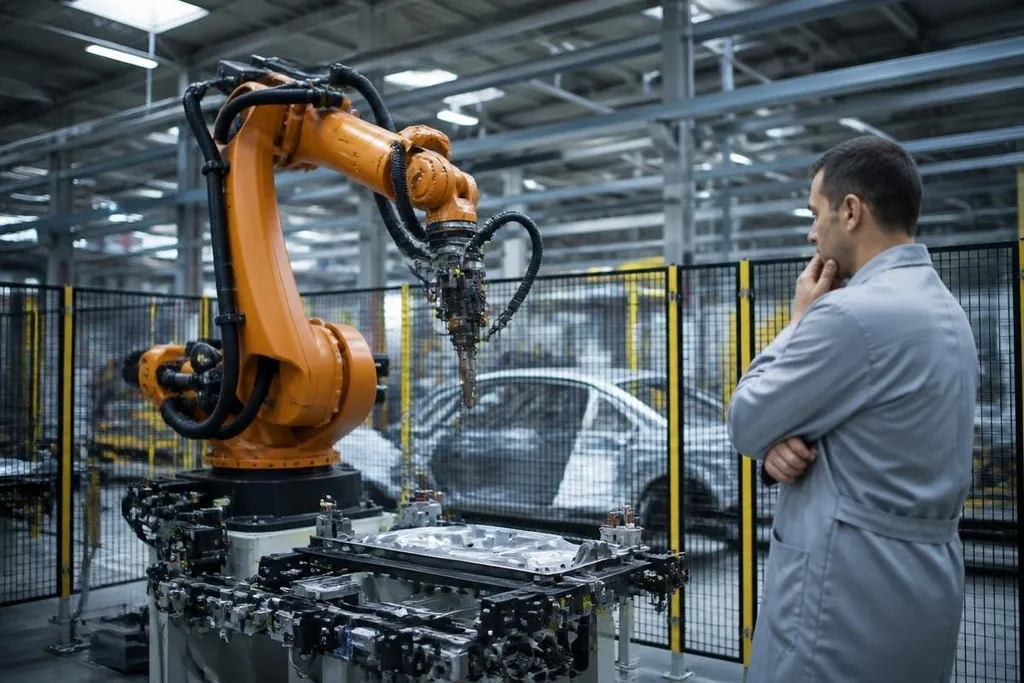
Factory robots can weld car bodies, move parts, pack goods, and repeat the same motion through every shift. They can also stop a production line when a sensor fails, a product changes shape, or people work too close to the arm.
Quick read
- Robots suit repeatable work with fixed tools, parts, and safety zones.
- The main risks are poor integration, unsafe access, maintenance gaps, and job changes.
- A robot purchase needs a full line review, not a price check on the arm alone.
Where factory robots help
A robot works best when the task stays the same. Welding, painting, palletizing, machine tending, and part inspection can all follow set paths when the factory controls the part position and tool location.
That repeatability can keep results close from one cycle to the next. A welding robot, for example, can place a torch along the same programmed path while a technician checks the weld system, wire feed, and safety equipment.
The gain comes from the whole work cell. The arm needs a gripper, fixture, controller, sensors, guarding, and software. If one part is poorly chosen, the arm may wait for parts, drop them, or stop when a sensor sees an object in the wrong place.
Robots can also take on work that creates strain or exposure for people. A machine tending cell can move hot parts from a press, while a paint system can keep people away from airborne chemicals. The factory still needs trained staff to set up, inspect, and maintain that equipment.
Where the risks begin
Safety is the first concern because an industrial arm can move with enough force to injure someone. A guarded cell, interlocked gate, emergency stop, and tested operating procedure must match the robot's motion and the way people use the area.
The danger often appears during setup or repair. A person may enter the cell to clear a jam, adjust a fixture, or change a tool.
Safe speed settings, lockout procedures, and training matter at those moments because normal automatic operation is no longer the only condition to plan for.
Integration creates another risk. The arm may work well in a test area yet fail beside a conveyor, press, camera, or older controller. Timing errors can send parts into the wrong position, while a weak fixture can make a good program produce bad work.
Software and network links need care too. A connected robot can exchange production data with other systems, but that connection adds another route for faults or unwanted access. Access controls, software updates, backups, and clear recovery steps belong in the factory plan.
Factory plans need evidence from live cells, not only a short demo. Robot 24 can give a plant manager named machines, companies, and test results to check before approving equipment for production. That evidence also helps set the full cost.
The cost is larger than the arm
The quoted robot price may cover the arm and controller. It may not cover the gripper, fixture, vision system, safety fence, tooling, installation, programming, staff training, maintenance parts, or changes to nearby equipment.
Those extra pieces decide whether the cell works. A cheap arm with a poor fixture can waste more time than it saves, while a suitable gripper may let the same arm handle parts without repeated manual adjustment.
Maintenance also changes the calculation. Motors, gearboxes, cables, sensors, and end effectors can wear out. The factory needs spare parts and a plan for faults, or one failed component can stop the work around it.
Job changes matter too. A robot built for one product may need new tooling and new software when the part changes. That work can take time, and some tasks may still need a person because the product arrives in a different position each cycle.
I'd judge a factory robot by the full work cell and its worst normal fault, not by the arm's speed on a clean demo.
A buying checklist
Before approving a factory robot project, check these points:
- Name the task: record the part, cycle, tool, reach, payload, and handoff point.
- Map the cell: include conveyors, presses, people, gates, sensors, and service access.
- Test the variation: run parts with the real range of size, weight, finish, and position.
- Price the full system: add tooling, guarding, installation, software, training, and spare parts.
- Plan the fault: write down how staff will stop, isolate, inspect, and restart the cell.
- Set the change plan: decide who will update programs when products or tools change.
A factory robot earns its place when the task is repeatable, the safety plan works during faults, and the full cell cost fits the output. If those three checks fail, buying the arm first only moves the problem into production.